
Smart Contract Security: Common Vulnerabilities, Audit Methods, Formal Verification, and Research Challenges
Introduction
Smart contracts have become a core component of modern blockchain ecosystems, enabling automated, trustless execution of agreements without intermediaries. From decentralised finance platforms to supply chain systems and digital identity frameworks, smart contracts are powering a wide range of applications.
However, their increasing adoption has also exposed significant security risks. Unlike traditional software systems, vulnerabilities in smart contracts can lead to irreversible financial losses and systemic failures. Once deployed, many smart contracts cannot be easily modified, making security a critical concern at every stage of development.
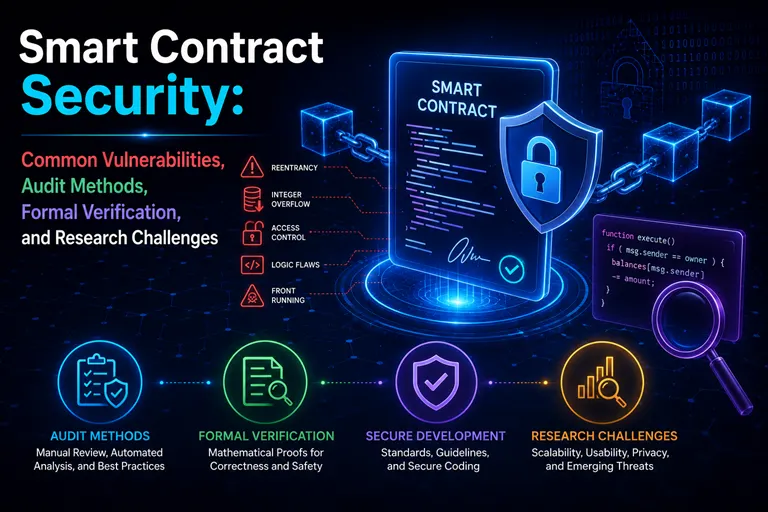
In 2026, smart contract security is one of the most important research areas in blockchain technology. The Journal of Emerging Trends in Blockchain Technology (JETBT) recognises the need for rigorous research in this domain to build secure, reliable, and scalable decentralised systems.
Understanding Smart Contract Security
What Are Smart Contracts
Smart contracts are self-executing programs stored on a blockchain that automatically enforce predefined rules when specific conditions are met.
They are widely used in:
- Decentralised finance platforms
- Token issuance and digital assets
- Supply chain automation
- Voting and governance systems
Why Security Matters
Smart contracts often manage high-value assets and sensitive operations. Security failures can result in:
- Loss of funds
- Exploitation of vulnerabilities
- Damage to user trust
- Legal and regulatory complications
Ensuring the correctness and robustness of smart contracts is therefore essential.
Common Smart Contract Vulnerabilities
Reentrancy Attacks
Reentrancy occurs when a contract allows external calls to re-enter the same function before the initial execution is completed. This can enable attackers to repeatedly withdraw funds.
Integer Overflow and Underflow
Arithmetic operations in smart contracts can produce incorrect results if limits are exceeded, leading to unintended behaviour.
Access Control Issues
Improperly defined permissions can allow unauthorised users to execute sensitive functions.
Front-Running and Transaction Ordering
Attackers can exploit transaction visibility to manipulate execution order, gaining unfair advantages in trading or auctions.
Denial of Service Attacks
Contracts may become unusable if attackers exploit logic that prevents execution under certain conditions.
Oracle Manipulation
Smart contracts often depend on external data sources. If these sources are compromised, the contract may execute incorrect actions.
Timestamp Dependence
Using block timestamps for critical decisions can introduce vulnerabilities due to potential manipulation by miners or validators.
Smart Contract Auditing Methods
Importance of Auditing
Auditing is a systematic process of reviewing smart contract code to identify vulnerabilities before deployment.
Manual Code Review
Experts analyse contract logic to detect potential flaws and ensure adherence to best practices.
Automated Analysis Tools
Static and dynamic analysis tools help identify vulnerabilities efficiently.
Common approaches include:
- Static code analysis
- Symbolic execution
- Fuzz testing
Formal Audit Frameworks
Structured audit frameworks provide standardised methodologies for evaluating smart contract security.
These frameworks include:
- Code quality assessment
- Vulnerability detection
- Risk evaluation
- Documentation review
Continuous Monitoring
Security does not end after deployment. Continuous monitoring helps detect anomalies and respond to threats in real time.
Formal Verification in Smart Contracts
What is Formal Verification
Formal verification uses mathematical methods to prove that a smart contract behaves as intended under all possible conditions.
Benefits of Formal Verification
- Eliminates ambiguity in contract logic
- Provides strong guarantees of correctness
- Reduces the risk of critical vulnerabilities
Techniques Used
- Model checking
- Theorem proving
- Constraint solving
Challenges in Adoption
Despite its advantages, formal verification faces challenges such as:
- High complexity
- Limited tool support
- Need for specialised expertise
Researchers are working to make these techniques more accessible and scalable.
Security Best Practices for Smart Contract Development
Secure Coding Practices
Developers should follow established coding standards and guidelines to minimise vulnerabilities.
Use of Tested Libraries
Reusing audited and widely accepted libraries reduces the risk of introducing new vulnerabilities.
Multi-Signature Mechanisms
Multi-signature systems enhance security by requiring multiple approvals for critical operations.
Upgradeable Contract Design
Designing contracts with upgradeability can help address vulnerabilities after deployment, though it introduces governance considerations.
Thorough Testing
Extensive testing, including unit testing and integration testing, is essential for identifying issues before deployment.
Emerging Research Challenges
Scalability and Security Trade-offs
Balancing security with performance remains a key challenge. More secure systems often require additional computational resources.
Secure Integration with External Systems
Smart contracts interact with off-chain systems, increasing complexity and risk.
Privacy-Preserving Smart Contracts
Ensuring confidentiality while maintaining transparency is a significant research challenge.
AI-Driven Security Analysis
Artificial intelligence is being explored to automate vulnerability detection and improve auditing processes.
Standardisation of Security Practices
The lack of universal standards makes it difficult to ensure consistent security across platforms.
Interdisciplinary Perspectives
Legal and Regulatory Implications
Smart contract vulnerabilities can lead to legal disputes and regulatory challenges. Understanding legal frameworks is essential.
Economic Impact
Security failures can affect market stability and investor confidence in decentralised systems.
Ethical Considerations
Developers must consider the ethical implications of automated systems that operate without human intervention.
Why This Topic Matters for Researchers
Smart contract security is critical for the sustainability of blockchain ecosystems.
Researchers can contribute by:
- Developing advanced auditing techniques
- Improving formal verification methods
- Designing secure contract architectures
- Exploring interdisciplinary solutions
High-quality research in this area can significantly enhance the reliability of decentralised systems.
Frequently Asked Questions
What is a smart contract vulnerability?
It is a flaw in the contract code that can be exploited to alter its intended behaviour.
Why is auditing important?
Auditing helps identify and fix vulnerabilities before deployment, reducing the risk of exploitation.
What is formal verification?
It is a mathematical approach to proving the correctness of a smart contract.
Are smart contracts completely secure?
No system is completely secure, but proper design, auditing, and verification can significantly reduce risks.
What are future research directions?
Future research focuses on automation, scalability, privacy, and standardisation in smart contract security.
Conclusion
Smart contract security is a foundational requirement for the success of blockchain-based systems. As decentralised applications continue to grow, ensuring the integrity, reliability, and safety of smart contracts becomes increasingly important.
The challenges associated with vulnerabilities, auditing, and formal verification highlight the need for ongoing research and innovation. By addressing these challenges, researchers can contribute to building secure and trustworthy blockchain ecosystems.
The Journal of Emerging Trends in Blockchain Technology (JETBT) remains committed to publishing research that advances smart contract security and strengthens the overall blockchain landscape.
Researchers and practitioners are encouraged to submit their work and engage with this critical area of study.