
Blockchain for Cybersecurity: Protecting Data, Networks, and Digital Infrastructure
Introduction
As digital transformation accelerates across industries, cybersecurity has become one of the most critical challenges of the modern era. Organisations are increasingly dependent on interconnected systems, cloud infrastructure, and data-driven technologies, making them vulnerable to cyberattacks, data breaches, and system failures.
Traditional cybersecurity models often rely on centralised architectures, which can create single points of failure and increase risk exposure. Blockchain technology introduces a decentralised and tamper-resistant approach to security, offering new ways to protect data, networks, and digital infrastructure.
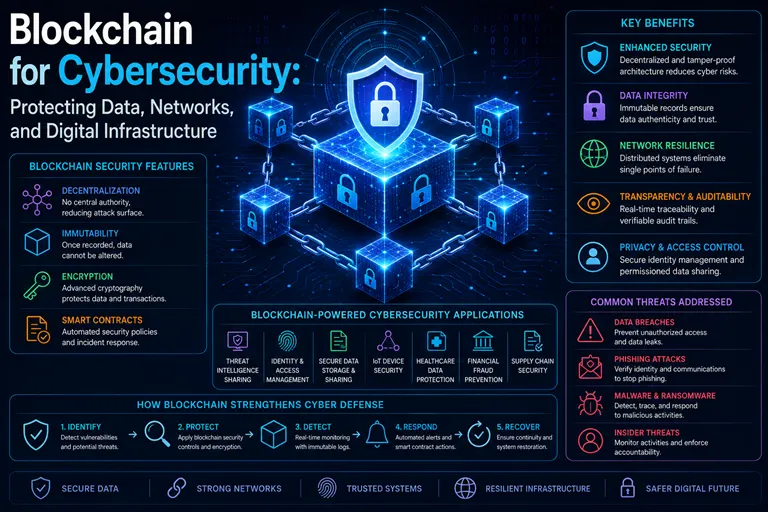
In 2026, blockchain is emerging as a powerful tool in cybersecurity strategies, enabling secure data management, resilient network architectures, and enhanced trust mechanisms. The Journal of Emerging Trends in Blockchain Technology (JETBT) recognises cybersecurity as a key application domain where blockchain can provide transformative solutions.
Understanding Cybersecurity Challenges
Increasing Threat Landscape
Modern cyber threats include:
- Data breaches and ransomware attacks
- Distributed denial-of-service attacks
- Identity theft and phishing
- Insider threats
- Supply chain attacks
These threats are becoming more sophisticated, targeting both organisations and critical infrastructure.
Limitations of Traditional Security Models
Centralised systems often suffer from:
- Single points of failure
- Limited transparency
- Delayed threat detection
- Vulnerability to data manipulation
These limitations highlight the need for innovative security approaches.
How Blockchain Enhances Cybersecurity
Decentralisation and Resilience
Blockchain distributes data across multiple nodes, reducing reliance on a central authority.
Benefits include:
- Elimination of single points of failure
- Increased system resilience
- Improved fault tolerance
Immutable Data Storage
Once data is recorded on a blockchain, it cannot be altered without consensus.
This ensures:
- Data integrity
- Protection against tampering
- Reliable audit trails
Cryptographic Security
Blockchain uses advanced cryptographic techniques to secure data and transactions.
Key features include:
- Public and private key encryption
- Digital signatures
- Hashing algorithms
Blockchain Applications in Cybersecurity
Secure Data Management
Blockchain can be used to store and verify critical data, ensuring authenticity and integrity.
Applications include:
- Secure document storage
- Data verification systems
- Tamper-proof audit logs
Identity and Access Management
Blockchain enables decentralised identity systems that improve authentication and access control.
Benefits include:
- Reduced risk of identity theft
- Enhanced user privacy
- Secure authentication processes
Network Security
Blockchain can secure communication networks by:
- Verifying device identities
- Preventing unauthorised access
- Detecting anomalies
Supply Chain Security
Blockchain helps secure supply chains by ensuring the authenticity of components and data.
Blockchain for Protecting Digital Infrastructure
Critical Infrastructure Security
Blockchain can enhance the security of critical systems such as:
- Power grids
- Transportation networks
- Financial systems
Cloud Security
Blockchain improves cloud security by providing:
- Decentralised data storage
- Secure data sharing
- Transparent access logs
Internet of Things Security
IoT devices are vulnerable to cyberattacks. Blockchain enables:
- Secure device authentication
- Data integrity verification
- Decentralised device management
Integration with Artificial Intelligence
AI-Driven Threat Detection
Artificial intelligence can analyse blockchain data to identify suspicious patterns and detect threats in real time.
Automated Security Responses
Smart contracts can trigger automated responses to security incidents.
Predictive Analytics
AI models can predict potential vulnerabilities and improve security planning.
Challenges in Blockchain-Based Cybersecurity
Scalability Issues
Blockchain systems must handle large volumes of security-related data efficiently.
Implementation Complexity
Integrating blockchain into existing systems requires technical expertise.
Regulatory Concerns
Compliance with data protection laws is essential.
Performance Trade-offs
Balancing security, scalability, and performance remains a challenge.
Emerging Trends in Blockchain Cybersecurity
Zero-Knowledge Proofs
Privacy-preserving cryptographic techniques are enhancing secure data sharing.
Decentralised Security Frameworks
Distributed security models are replacing traditional centralised approaches.
Cross-Chain Security Solutions
Interoperable systems enable secure communication across multiple blockchain networks.
Quantum-Resistant Cryptography
Research is focusing on cryptographic methods that can withstand future quantum computing threats.
Interdisciplinary Perspectives
Legal and Regulatory Frameworks
Cybersecurity solutions must comply with global regulations and standards.
Economic Impact
Cyberattacks can result in significant financial losses, making security investments essential.
Ethical Considerations
Ensuring ethical use of security technologies is critical for maintaining trust.
Why This Topic Matters for Researchers
Blockchain cybersecurity is a rapidly evolving field with significant real-world implications.
Researchers can contribute by:
- Developing secure blockchain architectures
- Designing advanced cryptographic solutions
- Exploring AI integration for threat detection
- Addressing scalability and regulatory challenges
JETBT encourages research that advances cybersecurity solutions using blockchain technology.
Frequently Asked Questions
How does blockchain improve cybersecurity?
It enhances security through decentralisation, immutability, and cryptographic protection.
Can blockchain prevent cyberattacks?
It reduces vulnerabilities but must be combined with other security measures.
What industries benefit from blockchain cybersecurity?
Finance, healthcare, supply chain, and critical infrastructure sectors benefit significantly.
What are the main challenges?
Scalability, complexity, and regulatory compliance are key challenges.
What is the future of blockchain in cybersecurity?
Increased adoption, integration with AI, and development of advanced cryptographic solutions.
Conclusion
Blockchain technology is transforming cybersecurity by providing decentralised, transparent, and secure solutions for protecting data, networks, and digital infrastructure. As cyber threats continue to evolve, the need for innovative security approaches becomes increasingly important.
While challenges remain, ongoing research and technological advancements are driving the development of scalable and effective blockchain-based security systems.
The Journal of Emerging Trends in Blockchain Technology (JETBT) remains committed to publishing high-quality research that explores the role of blockchain in cybersecurity and its impact on modern digital systems.
Researchers, institutions, and practitioners are encouraged to contribute to this critical field and help shape the future of secure digital infrastructure.