
Zero-Knowledge Proofs in Blockchain: Privacy, Scalability, and Real-World Applications
Introduction
As blockchain adoption grows across financial systems, digital identity platforms, and enterprise applications, the need for privacy and scalability has become increasingly critical. Public blockchains are inherently transparent, which creates challenges when handling sensitive data or high transaction volumes.
Zero-knowledge proofs (ZKPs) have emerged as a powerful cryptographic solution that allows one party to prove the validity of information without revealing the information itself. This capability is transforming how privacy and scalability are addressed in blockchain systems.
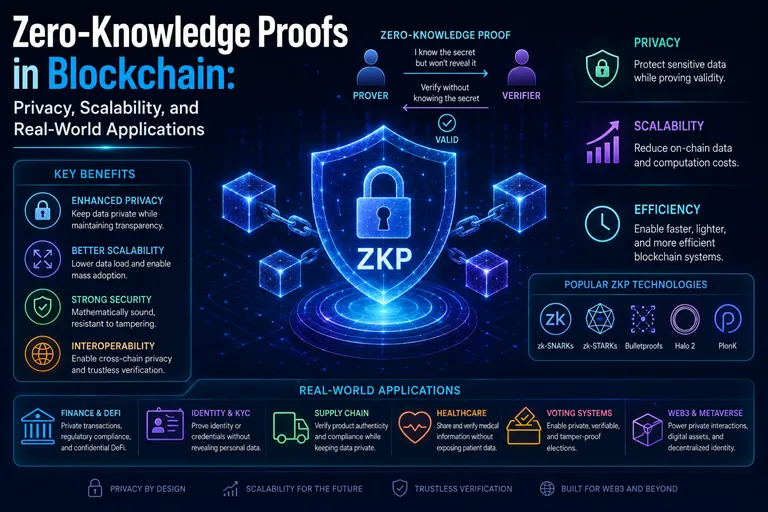
In 2026, zero-knowledge technologies are at the forefront of blockchain research and innovation. The Journal of Emerging Trends in Blockchain Technology (JETBT) recognises ZKPs as a foundational advancement that enables secure, efficient, and privacy-preserving decentralised systems.
Understanding Zero-Knowledge Proofs
What is a Zero-Knowledge Proof
A zero-knowledge proof is a cryptographic method through which a prover can demonstrate to a verifier that a statement is true without revealing any underlying data.
The concept is based on three key properties:
- Completeness: If the statement is true, the verifier will be convinced
- Soundness: If the statement is false, the verifier will not be misled
- Zero-knowledge: No additional information is revealed beyond the validity of the statement
Why ZKPs Matter in Blockchain
Blockchain systems require both transparency and privacy. ZKPs allow:
- Verification of transactions without revealing transaction details
- Secure authentication without exposing sensitive data
- Efficient validation processes that improve scalability
Types of Zero-Knowledge Proofs
zk-SNARKs
Zero-Knowledge Succinct Non-Interactive Arguments of Knowledge are widely used due to their efficiency and compact proof size.
Key features include:
- Fast verification
- Small proof sizes
- Suitability for blockchain applications
However, zk-SNARKs require a trusted setup, which introduces potential risks.
zk-STARKs
Zero-Knowledge Scalable Transparent Arguments of Knowledge address some limitations of zk-SNARKs by eliminating the need for a trusted setup.
Advantages include:
- Greater transparency
- Higher scalability
- Strong cryptographic security
The trade-off is larger proof sizes compared to zk-SNARKs.
Bulletproofs
Bulletproofs are another form of zero-knowledge proofs designed for efficient range proofs without trusted setup requirements.
They are particularly useful in privacy-focused blockchain systems.
Privacy Enhancement in Blockchain
Confidential Transactions
ZKPs enable confidential transactions where transaction details such as amounts and participants remain hidden while still being verifiable.
Identity Protection
In decentralised identity systems, ZKPs allow users to prove attributes without revealing personal data.
For example:
- Proving age eligibility without sharing date of birth
- Verifying credentials without exposing full records
Data Sharing with Privacy
ZKPs support secure data sharing across institutions, ensuring that sensitive information is not exposed unnecessarily.
Scalability Improvements with ZKPs
ZK-Rollups
ZK-rollups aggregate multiple transactions into a single proof that is verified on-chain.
Benefits include:
- Significant reduction in on-chain data
- Higher transaction throughput
- Lower transaction costs
Off-Chain Computation
ZKPs enable complex computations to be performed off-chain while maintaining trust through verifiable proofs.
Reduced Network Load
By minimising the amount of data stored and processed on-chain, ZKPs improve overall network efficiency.
Real-World Applications of Zero-Knowledge Proofs
Financial Systems
ZKPs are used to enable private transactions and compliance-friendly financial systems.
Applications include:
- Confidential payments
- Regulatory-compliant transaction verification
- Secure financial reporting
Digital Identity Systems
ZKPs are central to decentralised identity frameworks, enabling privacy-preserving authentication.
Supply Chain Management
Blockchain systems use ZKPs to verify product authenticity and supply chain data without exposing sensitive business information.
Healthcare Systems
ZKPs enable secure sharing of medical data while preserving patient privacy.
Government and Public Services
Governments can use ZKPs for secure voting systems, identity verification, and public data management.
Security Considerations
Cryptographic Complexity
ZKPs rely on advanced cryptographic techniques, which require careful implementation to avoid vulnerabilities.
Trusted Setup Risks
Some ZKP systems depend on trusted setups, which can introduce security concerns if compromised.
Performance Trade-offs
While ZKPs improve scalability, generating proofs can be computationally intensive.
Implementation Challenges
Developers must ensure correctness and efficiency in integrating ZKPs into blockchain systems.
Research Challenges and Opportunities
Improving Efficiency
Reducing computational overhead and proof generation time is a key research focus.
Standardisation
Developing standard protocols for ZKP implementation across platforms.
Integration with Blockchain Systems
Ensuring seamless integration with existing blockchain architectures.
Privacy and Compliance
Balancing privacy with regulatory requirements remains a complex challenge.
Interdisciplinary Research
ZKPs intersect with:
- Cryptography
- Computer science
- Law and regulation
- Data privacy frameworks
Future Trends in Zero-Knowledge Technology
Widespread Adoption
ZKPs are expected to become standard components in blockchain systems.
Integration with AI
Combining ZKPs with artificial intelligence for secure data analysis and model validation.
Advanced Cryptographic Innovations
New proof systems are being developed to improve efficiency and usability.
Enterprise Adoption
Businesses are increasingly adopting ZKP-based solutions for secure data sharing and compliance.
Why This Topic Matters for Researchers
Zero-knowledge proofs represent a breakthrough in blockchain cryptography with far-reaching implications.
Researchers can contribute by:
- Developing new proof systems
- Improving scalability and efficiency
- Exploring real-world applications
- Addressing regulatory and ethical challenges
JETBT encourages research that advances privacy-preserving technologies and strengthens blockchain ecosystems.
Frequently Asked Questions
What is a zero-knowledge proof?
It is a method of proving the validity of information without revealing the information itself.
Why are ZKPs important in blockchain?
They enhance privacy, improve scalability, and enable secure verification processes.
What are zk-SNARKs and zk-STARKs?
They are two types of zero-knowledge proof systems with different features and trade-offs.
Are ZKPs widely used?
Yes, they are increasingly used in blockchain systems, especially for privacy and scalability solutions.
What are the challenges of ZKPs?
Challenges include computational complexity, implementation difficulty, and standardisation issues.
Conclusion
Zero-knowledge proofs are transforming blockchain technology by addressing two of its most critical challenges: privacy and scalability. By enabling secure and efficient verification without exposing sensitive data, ZKPs are paving the way for more advanced and practical blockchain applications.
From financial systems and digital identity to healthcare and governance, the impact of ZKPs is far-reaching and continues to grow. However, challenges related to efficiency, standardisation, and integration highlight the need for continued research and innovation.
The Journal of Emerging Trends in Blockchain Technology (JETBT) remains committed to publishing high-quality research in this rapidly evolving field.
Researchers, institutions, and practitioners are encouraged to contribute to the advancement of zero-knowledge technologies and help shape the future of privacy-preserving blockchain systems.