
Tokenomics and Digital Asset Economics: Designing Sustainable Blockchain Ecosystems
Introduction
Blockchain technology has introduced a new form of digital economy driven by tokens, incentives, and decentralised participation. Unlike traditional financial systems, blockchain ecosystems rely on carefully designed token models to ensure sustainability, growth, and user engagement.
In 2026, tokenomics has become a critical area of research, influencing the success or failure of blockchain projects. Poorly designed token systems can lead to instability, speculation, and network collapse, while well-structured token economies can create long-term value and ecosystem resilience.
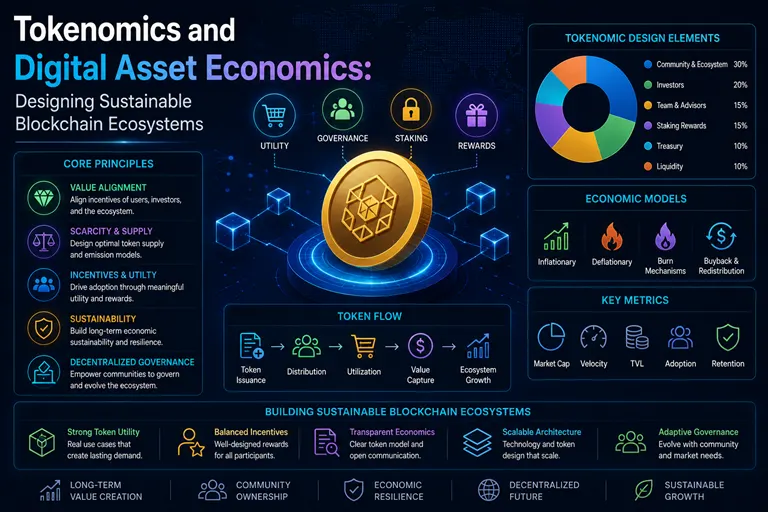
The Journal of Emerging Trends in Blockchain Technology (JETBT) recognises tokenomics as a key research domain that bridges blockchain technology with economics, game theory, and behavioural science. This article explores the principles of tokenomics, digital asset economics, and research directions for designing sustainable blockchain ecosystems.
Understanding Tokenomics
What is Tokenomics
Tokenomics refers to the design and management of digital tokens within a blockchain ecosystem, including their creation, distribution, utility, and economic incentives.
It combines elements of:
- Economics
- Cryptography
- Game theory
- Network design
Why Tokenomics Matters
Tokenomics determines:
- How participants are incentivised
- How value is created and distributed
- How the network grows and sustains itself
Without proper token design, even technically strong blockchain projects may fail.
Core Components of Tokenomics
Token Supply Models
Token supply plays a crucial role in economic stability.
Common models include:
- Fixed supply tokens
- Inflationary tokens
- Deflationary tokens
Each model has different implications for scarcity, value, and user behaviour.
Token Distribution
Initial token allocation affects fairness and decentralisation.
Distribution methods include:
- Initial coin offerings
- Airdrops
- Mining or staking rewards
- Treasury-controlled allocation
Utility and Use Cases
Tokens must have clear utility within the ecosystem, such as:
- Transaction fees
- Governance participation
- Access to services
- Staking and rewards
Incentive Mechanisms
Incentives encourage user participation and network growth.
Examples include:
- Staking rewards
- Liquidity incentives
- Governance participation rewards
Economic Models in Blockchain Ecosystems
Supply and Demand Dynamics
Token value is influenced by demand for network services and token availability.
A well-balanced system ensures that demand grows alongside network usage while supply is managed effectively.
Network Effects
As more users join a blockchain network, its value increases, creating positive feedback loops.
Game-Theoretic Design
Tokenomics relies heavily on game theory to ensure that participants act in ways that benefit the network.
Examples include:
- Incentivising honest behaviour in consensus mechanisms
- Penalising malicious actions
- Aligning user interests with network goals
Designing Sustainable Token Economies
Long-Term Value Creation
Sustainable ecosystems focus on long-term value rather than short-term speculation.
Key strategies include:
- Encouraging real utility
- Limiting excessive token inflation
- Promoting active participation
Balancing Incentives
Over-incentivisation can lead to unsustainable growth, while under-incentivisation can reduce participation.
Designing balanced reward systems is critical.
Governance Integration
Token holders often participate in governance decisions, influencing protocol upgrades and policies.
This creates a direct link between economic incentives and decision-making.
Treasury Management
Many blockchain projects maintain treasuries to fund development and ecosystem growth.
Effective treasury management ensures long-term sustainability.
Types of Tokens in Blockchain Ecosystems
Utility Tokens
Used for accessing services within a blockchain network.
Governance Tokens
Allow holders to participate in decision-making processes.
Security Tokens
Represent ownership in assets and may be subject to regulatory frameworks.
Stablecoins
Designed to maintain stable value, often pegged to fiat currencies or assets.
Tokenomics in Decentralised Finance (DeFi)
Liquidity Incentives
DeFi platforms use tokens to incentivise users to provide liquidity.
Yield Farming
Users earn rewards by participating in financial protocols, creating dynamic economic systems.
Risk Considerations
- Token inflation
- Market volatility
- Liquidity imbalances
Research is needed to design stable and secure DeFi token economies.
Challenges in Tokenomics Design
Speculative Behaviour
Many token ecosystems are driven by speculation rather than utility.
Centralisation Risks
Large token holders may dominate governance and decision-making.
Regulatory Uncertainty
Different jurisdictions have varying rules regarding digital assets.
Economic Instability
Poorly designed token models can lead to:
- Price volatility
- Network collapse
- Loss of user trust
Emerging Trends in Digital Asset Economics
Dynamic Token Models
Adaptive token systems adjust supply and incentives based on network conditions.
AI-Driven Economic Models
Artificial intelligence is being used to optimise token distribution and predict market behaviour.
Cross-Chain Token Ecosystems
Interoperable tokens enable value transfer across multiple blockchain networks.
Real-World Asset Tokenisation
Tokenising real-world assets is expanding the scope of blockchain economies.
Interdisciplinary Perspectives
Economic Theory
Tokenomics applies traditional economic principles in decentralised environments.
Behavioural Economics
User behaviour plays a critical role in token adoption and usage.
Legal and Regulatory Frameworks
Compliance with financial regulations is essential for long-term sustainability.
Why This Topic Matters for Researchers
Tokenomics is central to the success of blockchain ecosystems.
Researchers can contribute by:
- Designing innovative economic models
- Analysing incentive structures
- Studying user behaviour in decentralised systems
- Developing sustainable token frameworks
JETBT encourages research that bridges technology and economics to build resilient blockchain ecosystems.
Frequently Asked Questions
What is tokenomics?
It is the study and design of economic systems within blockchain networks using digital tokens.
Why is tokenomics important?
It determines how value is created, distributed, and sustained within a blockchain ecosystem.
What are common token types?
Utility tokens, governance tokens, security tokens, and stablecoins.
What are the main challenges?
Speculation, centralisation, regulatory uncertainty, and economic instability.
What are future trends in tokenomics?
Dynamic models, AI-driven optimisation, and cross-chain ecosystems.
Conclusion
Tokenomics and digital asset economics are fundamental to the success of blockchain ecosystems. By designing effective incentive structures, managing token supply, and ensuring real-world utility, blockchain projects can achieve long-term sustainability and growth.
However, challenges such as speculation, centralisation, and regulatory complexity highlight the need for continuous research and innovation.
The Journal of Emerging Trends in Blockchain Technology (JETBT) remains committed to advancing research in tokenomics and digital asset economics.
Researchers, institutions, and practitioners are encouraged to contribute to this evolving field and help design the next generation of sustainable blockchain ecosystems.