
OJS vs ScholarJMS: Which Platform Is Better for a New Blockchain and Emerging Technology Journal?
Introduction
Launching a blockchain or computer science journal in 2026 requires more than academic intent. It demands a reliable, scalable, and user-friendly publishing infrastructure capable of handling complex submissions, peer-review workflows, and global discoverability requirements.
Two common choices for journal publishers are Open Journal Systems (OJS) and modern platforms like ScholarJMS. While OJS has been widely used for years, the demands of emerging technology journals are pushing editors toward more advanced, integrated solutions.
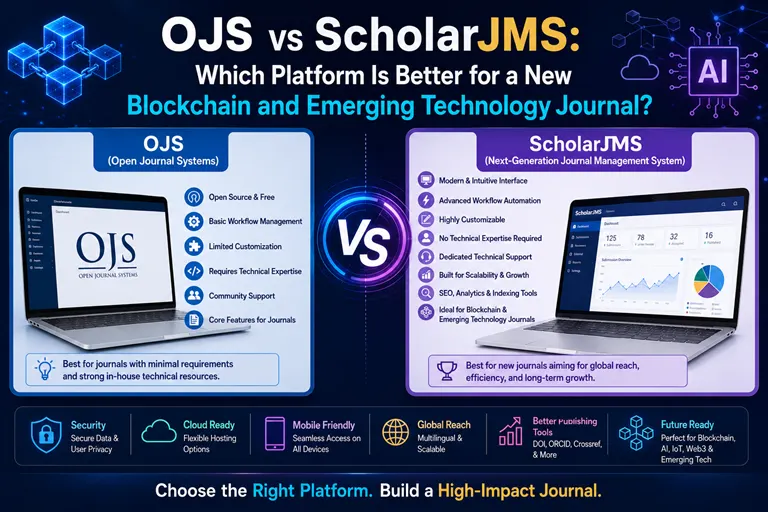
The Journal of Emerging Trends in Blockchain Technology (JETBT) operates in a domain where technical complexity, data-heavy submissions, and interdisciplinary collaboration require efficient editorial systems. This makes the choice of platform critically important.
This article provides a practical, experience-driven comparison of OJS and ScholarJMS to help universities, institutions, and journal founders choose the right platform.
Understanding OJS and ScholarJMS
What is OJS
Open Journal Systems is an open-source journal management platform designed to handle manuscript submission, peer review, and publishing workflows. It is widely used by academic institutions and small publishers.
What is ScholarJMS
ScholarJMS is a modern, fully integrated journal management platform designed for today's publishing needs. It combines website design, submission workflows, peer review, and article publishing into a single, streamlined system.
Core Comparison: OJS vs ScholarJMS
Ease of Setup and Launch
OJS requires installation, server configuration, plugin setup, and technical customisation. Many institutions face delays due to dependency on developers.
ScholarJMS, on the other hand, provides a ready-to-deploy environment where journals can go live quickly with minimal technical effort.
User Interface and Experience
OJS interfaces can feel outdated and complex for new users, particularly authors and reviewers.
ScholarJMS offers a clean, modern, and intuitive interface designed for:
- Easy manuscript submission
- Smooth reviewer interaction
- Efficient editorial decision-making
Workflow Automation
OJS supports workflows but often requires manual configuration and monitoring.
ScholarJMS provides built-in automation for:
- Submission tracking
- Reviewer invitations and reminders
- Editorial decisions
- Publication workflows
This significantly reduces administrative workload.
Technical Maintenance
OJS requires ongoing maintenance, including:
- Hosting management
- Software updates
- Plugin compatibility
- Security patches
With ScholarJMS, these technical responsibilities are handled within the platform, allowing editors to focus on publishing rather than system management.
Why Blockchain and Computer Science Journals Need More Than OJS
Handling Complex Submissions
Blockchain research often includes:
- Code repositories
- Simulation data
- Smart contract files
- Multi-format supplementary materials
A modern platform must support structured submission and management of such content.
Faster Review Cycles
In fast-moving fields like blockchain, delays in peer review can reduce the relevance of research.
Modern systems enable:
- Faster reviewer assignment
- Automated reminders
- Real-time tracking
Global Collaboration
Blockchain research is highly collaborative and international.
Editorial systems must support:
- Multi-author submissions
- Reviewer matching based on expertise
- Transparent communication
OJS with OJSCloud vs ScholarJMS
When OJSCloud is Useful
For journals that prefer to continue with OJS, OJSCloud provides:
- Managed hosting
- Technical support
- Journal setup and migration
- ISSN consulting support
This removes much of the technical burden associated with OJS.
Limitations Remain
Even with managed hosting, OJS still:
- Requires configuration effort
- Offers limited modern UI experience
- Lacks integrated advanced automation
ScholarJMS Advantage
ScholarJMS provides a complete ecosystem where:
- Website + submission system + workflow are unified
- No separate hosting or plugin management is needed
- Editors and authors experience a streamlined workflow
Need Help Choosing the Right Platform?
We help journals make the right technology decisions based on their goals, scale, and subject area.
Our services include:
- ScholarJMS journal setup and onboarding
- OJS hosting, support, and migration via OJSCloud
- ISSN consulting and journal readiness
- Workflow design and optimisation
WhatsApp: +91 82003 85143
Email: inquiry@ojscloud.com
DOI and Indexing Readiness
Why DOI Matters
Every serious academic journal must assign DOIs to its articles for:
- Global discoverability
- Citation tracking
- Academic credibility
OJS vs ScholarJMS in DOI Integration
OJS requires manual configuration or plugin setup for DOI management.
ScholarJMS integrates DOI workflows more seamlessly within its publishing system.
GetDOI Support
GetDOI helps journals with:
- Crossref registration
- DOI assignment
- Metadata management
- Ongoing DOI workflow support
Scalability and Future Growth
OJS Scalability
OJS can scale but often requires:
- Server upgrades
- Performance optimisation
- Technical intervention
ScholarJMS Scalability
ScholarJMS is designed for scalability from the beginning, supporting:
- Growing submission volumes
- Multi-journal management
- High-performance publishing environments
Cost vs Value Perspective
OJS
- Low initial software cost
- High hidden costs in maintenance and development
ScholarJMS
- Subscription or service-based model
- Lower operational complexity
- Faster return on investment through efficiency
Common Mistakes When Choosing a Platform
Choosing Based Only on Cost
Free software can become expensive due to maintenance and inefficiencies.
Ignoring Author Experience
Poor submission systems discourage high-quality submissions.
Underestimating Workflow Complexity
Modern journals require structured workflows, not manual processes.
Delaying Platform Upgrade
Outdated systems limit growth and indexing potential.
Future of Journal Platforms
Integrated Publishing Ecosystems
Future platforms will combine submission, review, publication, and indexing in one system.
AI-Driven Workflow Optimisation
Automation and AI will improve reviewer selection and editorial decisions.
Transparent Peer Review
Platforms like Scholar9 will play a role in building trust and transparency in research publishing.
Frequently Asked Questions
Is OJS still a good option in 2026?
Yes, especially with managed services like OJSCloud, but it may not meet all modern workflow expectations.
Why are journals moving to modern platforms?
To improve efficiency, user experience, and scalability.
Can I migrate from OJS to ScholarJMS?
Yes, migration services are available to transfer your journal data and workflows.
Which platform is better for new journals?
Modern platforms like ScholarJMS are often better suited for new journals due to ease of setup and integrated features.
Do both platforms support DOI integration?
Yes, but ScholarJMS offers a more streamlined approach, especially when combined with GetDOI support.
Conclusion
Choosing the right platform is one of the most important decisions when launching a blockchain or emerging technology journal.
While OJS remains a widely used and flexible system, it often requires technical expertise, ongoing maintenance, and additional configuration to meet modern publishing demands.
ScholarJMS, on the other hand, offers a fully integrated, scalable, and user-friendly solution that aligns with the needs of contemporary academic publishing.
For institutions aiming to launch or upgrade their journals efficiently, combining ScholarJMS with OJSCloud support (where needed), GetDOI for DOI workflows, and Scholar9 for transparent peer review provides a complete, future-ready publishing ecosystem.
If you are planning to start or modernise your journal, now is the right time to choose a platform that supports long-term growth.
Contact us today:
WhatsApp: +91 82003 85143
Email: inquiry@ojscloud.com