
NFT Ecosystems Beyond Art: Use Cases in Identity, Gaming, IP Rights, and Education
Introduction
Non-Fungible Tokens (NFTs) initially gained global attention through digital art and collectibles, often associated with high-value transactions and speculative markets. However, as blockchain technology matures, NFTs are evolving into powerful tools for representing ownership, identity, and rights across multiple sectors.
In 2026, NFT ecosystems are expanding far beyond art, finding applications in digital identity, gaming, intellectual property management, and education systems. These use cases demonstrate the potential of NFTs to redefine ownership, authenticity, and value in digital environments.
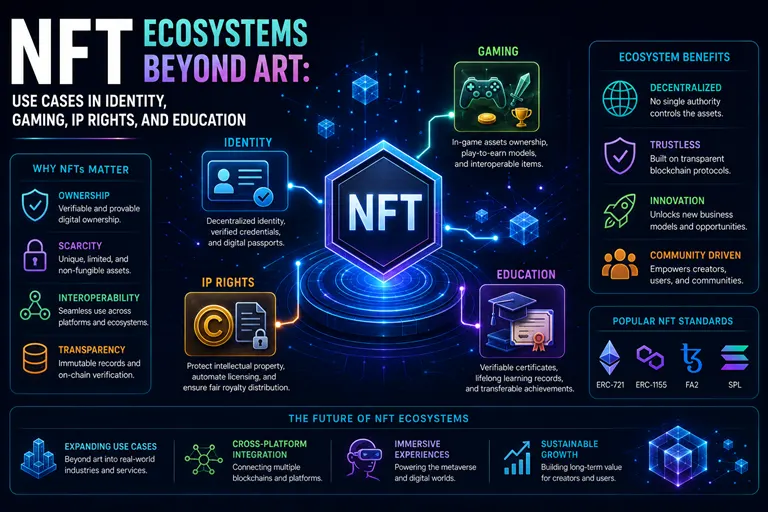
The Journal of Emerging Trends in Blockchain Technology (JETBT) recognises NFTs as a transformative innovation with interdisciplinary relevance. This article explores emerging NFT applications beyond art and highlights key research opportunities for scholars and practitioners.
Understanding NFTs
What is an NFT
A Non-Fungible Token is a unique digital asset stored on a blockchain that represents ownership of a specific item or piece of data.
Unlike cryptocurrencies, NFTs are not interchangeable, as each token has distinct properties and value.
Key Characteristics
- Uniqueness and indivisibility
- Ownership verification through blockchain
- Transferability across platforms
- Programmability through smart contracts
NFTs in Digital Identity
Identity Representation
NFTs can represent unique digital identities, enabling individuals to own and control their identity credentials.
Applications include:
- Decentralised identity systems
- Verifiable credentials
- Digital passports and access tokens
Benefits
- Enhanced privacy and control
- Reduced identity fraud
- Interoperable identity systems
Research Opportunities
- Secure identity frameworks using NFTs
- Integration with decentralised identity systems
- Privacy-preserving identity verification
NFTs in Gaming Ecosystems
Ownership of In-Game Assets
NFTs enable players to truly own digital assets such as:
- Characters
- Skins
- Weapons
- Virtual land
These assets can be traded or transferred across platforms.
Play-to-Earn Models
Gaming ecosystems are evolving into economic systems where players earn rewards through participation.
Interoperability
NFTs allow assets to move across different games and platforms, creating interconnected gaming ecosystems.
Challenges
- Balancing gameplay and economic incentives
- Preventing speculative behaviour
- Ensuring fair distribution of rewards
NFTs in Intellectual Property Rights
Digital Ownership of Content
NFTs provide a mechanism for creators to establish ownership of digital content, including:
- Music
- Videos
- Written works
- Software
Smart Contract Licensing
Smart contracts enable automated licensing and royalty distribution.
Protection Against Piracy
Blockchain records provide proof of ownership, reducing unauthorised use of content.
Research Opportunities
- Legal frameworks for NFT-based IP rights
- Automated royalty systems
- Cross-platform content protection
NFTs in Education
Academic Credentials
NFTs can be used to issue tamper-proof educational certificates and degrees.
Benefits include:
- Instant verification
- Reduced fraud
- Global accessibility
Lifelong Learning Records
Students can maintain a digital portfolio of achievements using NFTs.
Educational Content Ownership
Educators can use NFTs to distribute and monetise digital learning materials.
Research Opportunities
- Standardisation of NFT-based credentials
- Integration with global education systems
- Privacy-preserving academic records
Economic Models of NFT Ecosystems
Token Value and Utility
NFT value is driven by utility, scarcity, and demand within the ecosystem.
Creator Economy
NFTs enable direct interaction between creators and users, reducing reliance on intermediaries.
Marketplace Dynamics
NFT marketplaces facilitate buying, selling, and trading of digital assets.
Challenges in NFT Adoption
Regulatory Uncertainty
Legal frameworks for NFTs are still evolving.
Scalability Issues
High transaction costs and network congestion can limit adoption.
Environmental Concerns
Energy consumption in blockchain networks remains a concern.
Market Volatility
Speculative behaviour can lead to price instability.
Emerging Trends in NFT Ecosystems
Utility-Driven NFTs
Focus is shifting from speculative assets to functional use cases.
Integration with Metaverse
NFTs are becoming central to virtual environments and digital economies.
Cross-Chain NFTs
Interoperability across blockchain networks is improving NFT usability.
AI-Generated NFTs
Artificial intelligence is being used to create and manage digital assets.
Interdisciplinary Perspectives
Legal Considerations
Understanding ownership rights and regulatory compliance is essential.
Economic Impact
NFTs are reshaping digital economies and monetisation models.
Social Implications
NFTs influence how individuals interact with digital assets and communities.
Why This Topic Matters for Researchers
NFT ecosystems are evolving rapidly, offering numerous research opportunities.
Researchers can contribute by:
- Exploring new use cases beyond art
- Designing sustainable NFT economic models
- Addressing regulatory and ethical challenges
- Developing interoperable NFT systems
JETBT encourages research that advances the understanding and application of NFTs in diverse domains.
Frequently Asked Questions
What are NFTs?
Unique digital assets stored on a blockchain representing ownership of specific items or data.
Are NFTs only used for art?
No, NFTs are increasingly used in identity, gaming, intellectual property, and education.
How do NFTs ensure ownership?
Ownership is recorded on a blockchain, providing a tamper-proof record.
What are the challenges of NFTs?
Regulatory uncertainty, scalability issues, and market volatility are key challenges.
What is the future of NFTs?
NFTs will become more utility-driven and integrated into digital ecosystems.
Conclusion
NFT ecosystems are evolving beyond digital art into powerful tools for representing ownership, identity, and value across multiple sectors. From gaming and education to intellectual property and digital identity, NFTs are enabling new forms of interaction and economic activity.
While challenges remain, ongoing research and innovation are driving the development of scalable, sustainable, and practical NFT applications.
The Journal of Emerging Trends in Blockchain Technology (JETBT) remains committed to publishing research that explores these emerging trends and their real-world implications.
Researchers, institutions, and practitioners are encouraged to contribute to this dynamic field and help shape the future of NFT ecosystems.