
Why Blockchain and Computer Science Journals Need a Modern Manuscript Submission and Peer-Review System
Introduction
The rapid evolution of blockchain and computer science research has significantly increased the complexity, volume, and technical depth of scholarly submissions. Traditional journal management methods, including email-based submissions and outdated platforms, are no longer sufficient to handle modern research workflows.
In 2026, journals operating in advanced domains such as blockchain technology, artificial intelligence, cybersecurity, and distributed systems must adopt modern manuscript submission and peer-review systems to remain competitive, efficient, and credible.
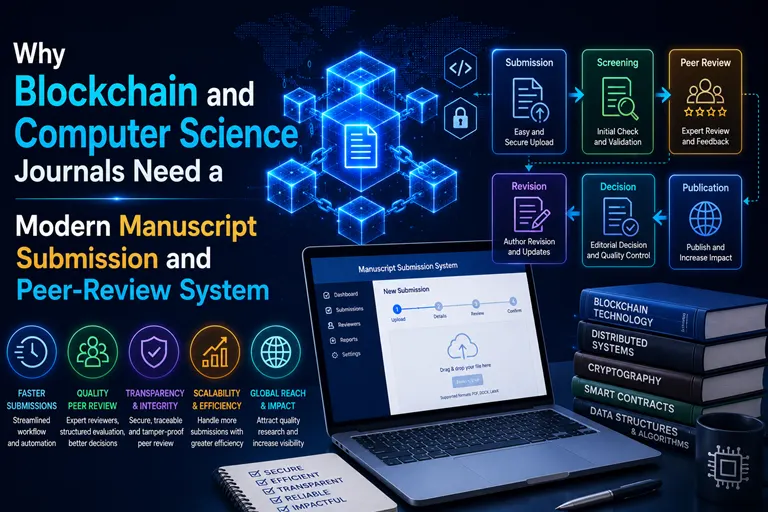
The Journal of Emerging Trends in Blockchain Technology (JETBT) reflects this shift by recognising the importance of robust editorial infrastructure in supporting high-quality research publication. This article explains why modern systems are essential and how they can transform journal operations.
Limitations of Traditional Journal Submission Systems
Manual and Email-Based Workflows
Many journals still rely on email submissions, spreadsheets, and manual tracking. This approach leads to:
- Loss of submission data
- Delayed communication with authors and reviewers
- Lack of transparency in editorial decisions
- Difficulty in tracking manuscript status
Outdated Platforms
Older systems, including poorly configured legacy platforms, often lack:
- Intuitive user interfaces
- Automated workflows
- Integration with indexing and DOI systems
- Scalable infrastructure
These limitations reduce efficiency and negatively impact the author experience.
Increasing Complexity of Blockchain and Computer Science Research
Technical Nature of Submissions
Research in blockchain and computer science often includes:
- Source code repositories
- Algorithmic models and simulations
- Large datasets
- Supplementary materials
Managing such complex submissions requires a system capable of handling diverse content formats.
Interdisciplinary Collaboration
Modern research involves collaboration across domains such as finance, cybersecurity, artificial intelligence, and law.
Editorial systems must support:
- Multi-author coordination
- Reviewer expertise matching
- Cross-disciplinary evaluation workflows
Key Features of a Modern Manuscript Submission System
Centralised Submission Management
A modern system provides a single platform for:
- Author submission
- Editorial screening
- Reviewer assignment
- Decision tracking
Automated Workflow Management
Automation reduces manual effort by handling:
- Submission acknowledgements
- Reviewer invitations
- Reminder notifications
- Status updates
Role-Based Access Control
Editors, reviewers, and authors have clearly defined roles, ensuring secure and organised workflow management.
Integrated Communication
All communication occurs within the platform, improving transparency and record-keeping.
Analytics and Reporting
Editors can track:
- Submission volumes
- Review timelines
- Acceptance rates
This helps improve decision-making and operational efficiency.
Why Peer Review Needs Modernisation
Challenges in Traditional Peer Review
- Difficulty in finding qualified reviewers
- Delays in review completion
- Lack of transparency
- Limited accountability
Benefits of Modern Peer Review Systems
Modern systems improve peer review by:
- Automating reviewer selection
- Providing structured review templates
- Enabling real-time tracking of review progress
- Supporting multiple review models
Transparent and Open Peer Review
The future of peer review is moving toward transparency.
Platforms like Scholar9 support:
- Transparent reviewer contributions
- Verified review histories
- Enhanced trust in the review process
Advantages for Authors, Editors, and Reviewers
For Authors
- Easy submission process
- Real-time status tracking
- Faster review and publication timelines
For Editors
- Efficient manuscript management
- Reduced administrative workload
- Improved decision-making through analytics
For Reviewers
- Structured review interfaces
- Clear deadlines and communication
- Recognition for contributions
Role of ScholarJMS in Modern Journal Management
All-in-One Journal Platform
ScholarJMS is designed to meet the needs of modern academic journals, particularly in technical fields such as blockchain and computer science.
It provides:
- Complete journal website setup
- Manuscript submission system
- Editorial workflow automation
- Reviewer management tools
- Article publishing infrastructure
Designed for Scalability
ScholarJMS supports journals at different stages, from new launches to high-volume publications.
SEO and Indexing Readiness
The platform ensures that journal content is structured for discoverability and indexing.
Need a Modern Submission System for Your Journal?
We help journals upgrade from outdated workflows to modern, efficient publishing systems.
Our services include:
- ScholarJMS platform setup
- OJS hosting and migration support
- Editorial workflow configuration
- ISSN consulting and journal readiness
- Crossref DOI integration support
WhatsApp: +91 82003 85143
Email: inquiry@ojscloud.com
OJS vs Modern Systems: The Practical Reality
Challenges with Self-Managed OJS
While Open Journal Systems is widely used, many journals face issues such as:
- Technical maintenance challenges
- Hosting and performance issues
- Limited user experience
- Dependence on external developers
OJSCloud as a Managed Solution
For journals that prefer OJS, OJSCloud offers:
- Managed hosting
- Technical support
- Journal setup assistance
- ISSN consulting
Why Many Journals Shift to Modern Platforms
Modern systems like ScholarJMS provide:
- Better usability
- Integrated workflow management
- Faster setup and support
- Reduced technical burden
Importance of DOI Integration
Why DOI Matters
Every research article should have a Digital Object Identifier for:
- Permanent accessibility
- Citation tracking
- Academic recognition
DOI Workflow Challenges
Manual DOI management can lead to errors and delays.
GetDOI Support
GetDOI simplifies DOI processes by offering:
- Crossref registration support
- DOI assignment and metadata management
- Workflow integration with journal platforms
Editorial Workflow Automation and Quality Improvement
Reducing Turnaround Time
Automation ensures faster processing from submission to publication.
Maintaining Consistency
Standardised workflows improve consistency in editorial decisions.
Enhancing Quality Control
Integrated plagiarism checks and review tracking improve research quality.
Common Mistakes Journals Make
Relying on Email-Based Systems
This leads to inefficiency and lack of transparency.
Ignoring User Experience
Poor interfaces discourage authors and reviewers.
Delaying Platform Upgrades
Outdated systems limit growth and scalability.
Lack of DOI and ISSN Planning
This affects indexing and recognition.
Future of Journal Publishing in Technology Domains
AI-Assisted Editorial Systems
Artificial intelligence is being used for reviewer selection, plagiarism detection, and content analysis.
Transparent Peer Review Ecosystems
Trust and transparency will become central to scholarly publishing.
Integrated Publishing Platforms
Future systems will combine submission, review, publication, and indexing into unified platforms.
Frequently Asked Questions
Why do blockchain journals need modern systems?
Because they handle complex submissions and require efficient, transparent workflows.
What is a manuscript submission system?
It is a platform that manages the entire process from submission to publication.
Can OJS handle modern requirements?
It can, but often requires technical support or managed services like OJSCloud.
What is the role of DOI in publishing?
DOI ensures permanent identification and accessibility of research articles.
Which platform is best for new journals?
Modern platforms like ScholarJMS provide integrated and scalable solutions.
Conclusion
Blockchain and computer science journals operate in one of the most technically demanding research environments. To manage complex submissions, ensure efficient peer review, and maintain high publication standards, modern manuscript submission and peer-review systems are no longer optional.
By adopting advanced platforms such as ScholarJMS, leveraging OJSCloud for managed services, integrating DOI workflows through GetDOI, and enhancing transparency with Scholar9, journals can significantly improve their operational efficiency and academic credibility.
If your journal is still relying on outdated systems, now is the right time to modernise.
Get in touch with us:
WhatsApp: +91 82003 85143
Email: inquiry@ojscloud.com