
How to Migrate an OJS Blockchain Journal to a Modern Publishing Platform Without Data Loss
Introduction
As blockchain and computer science research continues to evolve rapidly, journals operating in these domains must keep pace not only with academic developments but also with publishing technology. Many journals that initially adopted Open Journal Systems (OJS) are now facing limitations related to performance, usability, workflow complexity, and scalability.
Migrating from OJS to a modern publishing platform is a strategic step toward improving editorial efficiency, enhancing author experience, and preparing for indexing and long-term growth. However, one of the biggest concerns for journal editors and publishers is data loss during migration.
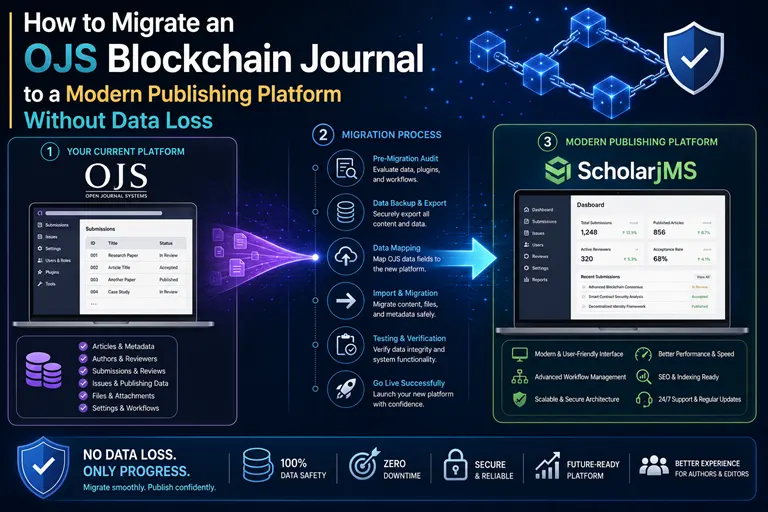
The Journal of Emerging Trends in Blockchain Technology (JETBT) recognises that successful migration requires careful planning, structured execution, and expert support. This guide provides a complete, practical framework for migrating an OJS-based blockchain journal to a modern system without losing valuable data.
Why Journals Migrate from OJS
Limitations of Traditional OJS Setup
While OJS is widely used, many journals encounter challenges such as:
- Complex user interface
- Manual workflow management
- Technical maintenance requirements
- Plugin dependency issues
- Performance and scalability limitations
Growing Needs of Blockchain Journals
Blockchain journals often handle:
- Data-intensive research submissions
- Code repositories and supplementary materials
- Interdisciplinary peer review workflows
These requirements demand a more advanced and integrated publishing system.
What Does “Migration Without Data Loss” Mean
Critical Data That Must Be Preserved
During migration, the following must remain intact:
- Published articles (PDF, HTML, supplementary files)
- Author and reviewer accounts
- Editorial decisions and review history
- Metadata (titles, abstracts, keywords)
- Volume, issue, and archive structure
- DOI links and article URLs
Risks of Poor Migration
Improper migration can result in:
- Broken links and DOI errors
- Missing articles or files
- Loss of reviewer history
- Metadata inconsistencies
- SEO ranking loss
Step-by-Step OJS Migration Strategy
Step 1: Pre-Migration Audit
Conduct a complete audit of your existing OJS system.
Checklist includes:
- Total number of articles
- File formats and storage structure
- Metadata completeness
- DOI status
- User accounts and roles
This step ensures that no data category is overlooked.
Step 2: Backup Everything
Before making any changes, create secure backups of:
- Database
- Uploaded files
- Configuration files
Backups should be stored in multiple locations to prevent accidental loss.
Step 3: Define Migration Scope
Decide what needs to be migrated:
- Full archive or selected issues
- Active submissions only or complete history
- User accounts and reviewer data
A clear scope prevents confusion during execution.
Step 4: Choose a Modern Platform
Selecting the right platform is critical.
A modern system like ScholarJMS offers:
- Integrated journal website
- Advanced manuscript submission system
- Automated editorial workflow
- Reviewer management tools
- SEO-ready article structure
This ensures long-term scalability and efficiency.
Need Help Migrating Your OJS Journal?
We specialise in safe and structured journal migration without data loss.
Our services include:
- OJS to ScholarJMS migration
- Complete data transfer and validation
- ISSN consulting and journal restructuring
- Workflow optimisation
- DOI preservation and integration
WhatsApp: +91 82003 85143
Email: inquiry@ojscloud.com
Step 5: Data Mapping and Transformation
Data from OJS must be mapped to the new platform structure.
This includes:
- Articles and files
- Metadata fields
- User roles
- Workflow states
Proper mapping ensures data integrity and usability.
Step 6: Metadata Validation
Ensure that all metadata is:
- Complete
- Consistent
- Standardised
This step is critical for SEO and indexing readiness.
Step 7: DOI Preservation and Integration
Why DOI Continuity Matters
Existing DOIs must continue to resolve correctly after migration.
Key Actions
- Maintain DOI URLs
- Update landing pages if needed
- Ensure metadata consistency
GetDOI Support
GetDOI helps with:
- DOI validation
- Metadata correction
- Crossref updates
- Ongoing DOI workflow support
Step 8: Testing and Quality Assurance
Before going live, thoroughly test:
- Article accessibility
- File downloads
- User login and roles
- Submission workflow
- DOI links
Testing ensures a smooth transition.
Step 9: Launch and Monitor
After migration:
- Monitor system performance
- Track user activity
- Address any issues quickly
Continuous monitoring helps maintain stability.
Role of OJSCloud in Migration
For journals currently using OJS, OJSCloud provides:
- Managed hosting
- Migration planning
- Technical support
- ISSN consulting
- Publishing guidance
This ensures a structured and risk-free transition.
Common Migration Mistakes to Avoid
Skipping Backup
Failure to back up data can lead to irreversible loss.
Ignoring Metadata
Incomplete metadata affects indexing and discoverability.
Breaking DOI Links
Incorrect DOI handling can damage journal credibility.
Rushing the Process
Migration should be carefully planned and executed in phases.
Lack of Testing
Insufficient testing leads to post-launch issues.
Benefits of Migrating to a Modern Platform
Improved Workflow Efficiency
Automation reduces manual workload and speeds up publication.
Better Author Experience
Simplified submission processes attract more submissions.
Enhanced SEO and Discoverability
Modern platforms are optimised for search engines and indexing.
Scalability
Supports growth in submissions and publications.
Integrated Publishing Ecosystem
Combining submission, review, and publishing in one system improves efficiency.
Future Trends in Journal Migration
Cloud-Based Publishing Platforms
More journals are moving to managed cloud environments.
AI-Assisted Migration
Automation tools are being developed to streamline migration processes.
Integrated Publishing Systems
Future platforms will provide end-to-end publishing solutions.
Frequently Asked Questions
Can I migrate my journal without losing data?
Yes, with proper planning, backups, and expert support, data loss can be avoided.
Will my DOI links break after migration?
No, if DOI mapping and updates are handled correctly.
How long does migration take?
It depends on journal size but typically ranges from a few days to a few weeks.
Do I need technical expertise?
Professional services can handle the technical aspects.
What is the best platform after OJS?
Modern systems like ScholarJMS provide integrated and scalable solutions.
Conclusion
Migrating an OJS blockchain journal to a modern publishing platform is a strategic decision that can significantly improve operational efficiency, user experience, and long-term growth.
However, successful migration requires careful planning, structured execution, and a strong focus on preserving data integrity. From metadata and DOIs to editorial workflows and user accounts, every element must be handled with precision.
By leveraging modern platforms like ScholarJMS, migration support from OJSCloud, and DOI management through GetDOI, journals can transition smoothly without data loss and position themselves for future success.
If you are planning to migrate your journal, now is the right time to take action.
Contact us today:
WhatsApp: +91 82003 85143
Email: inquiry@ojscloud.com