
Journal Indexing Readiness Checklist for Blockchain and Computer Science Journals in 2026
Introduction
For any academic journal, indexing is a major milestone that determines its visibility, credibility, and long-term impact. For blockchain and computer science journals, indexing becomes even more important due to the highly competitive and rapidly evolving nature of these research domains.
Many new journals struggle to get indexed not because of poor research quality, but due to lack of preparation in areas such as website structure, editorial processes, metadata quality, and publishing consistency.
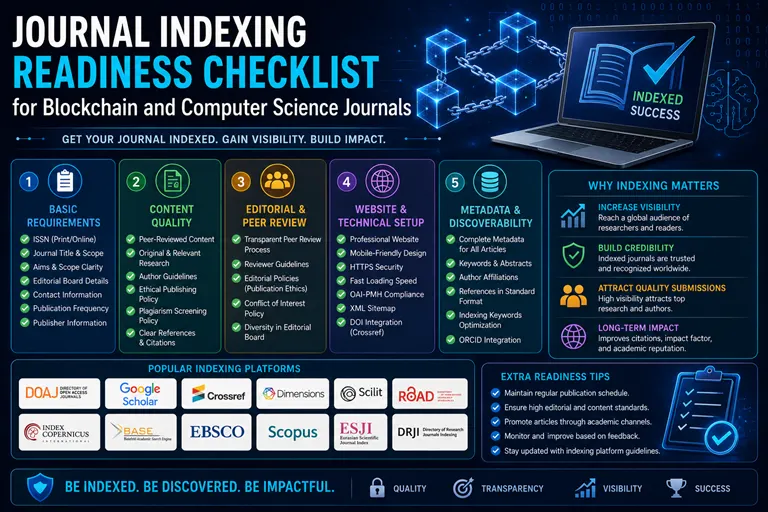
In 2026, indexing bodies such as Scopus, DOAJ, and other scholarly databases evaluate journals based on strict quality, transparency, and technical standards.
The Journal of Emerging Trends in Blockchain Technology (JETBT) recognises that indexing readiness must be planned from the early stages of journal development. This checklist provides a practical, step-by-step framework for editors, universities, and publishers to prepare their journals for successful indexing.
Understanding Journal Indexing
What is Journal Indexing
Journal indexing refers to the inclusion of a journal in recognised academic databases and repositories, making its content discoverable to researchers worldwide.
Why Indexing Matters
- Increases journal visibility and reach
- Improves citation potential
- Enhances academic credibility
- Attracts high-quality submissions
- Supports institutional recognition
Core Indexing Requirements
Basic Eligibility Criteria
Before applying for indexing, ensure your journal has:
- A clearly defined scope
- A professional journal website
- A functioning editorial board
- A structured peer-review process
- Published issues with consistent quality
Website Readiness Checklist
Essential Pages
Your journal website must include:
- Home
- About Journal
- Aims and Scope
- Editorial Board
- Author Guidelines
- Publication Ethics
- Peer Review Policy
- Contact Information
- Archive / Past Issues
- Current Issue
Technical Quality
- Mobile-friendly design
- Fast loading speed
- Secure HTTPS connection
- SEO-friendly URLs
- Clean navigation
Platform Recommendation
A modern system like ScholarJMS ensures your website is:
- Structured for indexing
- Metadata-ready
- Integrated with submission and publishing workflows
Need Help Preparing Your Journal for Indexing?
We help journals become fully indexing-ready with professional setup and guidance.
Our services include:
- ScholarJMS journal website setup
- OJS hosting and migration via OJSCloud
- ISSN consulting and documentation
- DOI setup and metadata support
- Editorial workflow configuration
WhatsApp: +91 82003 85143
Email: inquiry@ojscloud.com
Editorial and Peer Review Readiness
Editorial Board
- Qualified and diverse members
- International representation
- Clear roles and responsibilities
Peer Review Process
- Defined review model (single-blind, double-blind, or open)
- Transparent workflow
- Reviewer guidelines
- Ethical review practices
Workflow Management
Using a system like ScholarJMS ensures:
- Automated submission tracking
- Reviewer assignment
- Decision documentation
- Communication transparency
ISSN and DOI Requirements
ISSN
Your journal must have an ISSN (preferably e-ISSN for online journals).
OJSCloud can assist with ISSN consulting and application readiness.
DOI
Each article should have a DOI for:
- Persistent linking
- Citation tracking
- Indexing compatibility
GetDOI provides:
- Crossref registration support
- DOI assignment
- Metadata management
Metadata and SEO Readiness
Article-Level Metadata
Each article must include:
- Title
- Authors
- Abstract
- Keywords
- References
- Publication date
- DOI
Structured Data
Proper metadata improves:
- Search engine visibility
- Indexing accuracy
- Citation tracking
SEO Best Practices
- Keyword-optimised titles
- Clear headings
- Internal linking
- Fast-loading pages
Publication Quality Checklist
Content Standards
- Original research
- Proper citations
- Ethical compliance
- Plagiarism-free content
Publishing Consistency
- Regular issue publication
- Defined frequency (quarterly, biannual, etc.)
- Timely article release
Language Quality
- Clear academic English
- Proper formatting
- Consistent style
Technical and Infrastructure Readiness
Submission System
A structured manuscript submission system is essential.
Hosting and Performance
Reliable hosting ensures uptime and accessibility.
Security
- SSL encryption
- Secure login systems
- Data protection measures
Common Reasons Journals Get Rejected
Poor Website Structure
Incomplete or unprofessional websites reduce credibility.
Lack of Transparency
Missing policies or unclear editorial processes.
Irregular Publication
Inconsistent publishing schedules.
Weak Editorial Board
Limited expertise or lack of diversity.
Poor Metadata
Incomplete or incorrect article information.
Advanced Indexing Preparation
DOAJ Readiness
Focus on:
- Open access policies
- Licensing clarity
- Transparency in operations
Scopus Readiness
Emphasise:
- Academic quality
- International reach
- Citation performance
- Ethical publishing practices
Long-Term Strategy
Indexing is not immediate. It requires consistent quality and continuous improvement.
Future Trends in Journal Indexing
AI-Based Evaluation
Indexing bodies are increasingly using AI to evaluate journal quality.
Metadata-Driven Discoverability
Structured data will play a major role in search and indexing.
Open Science Movement
Transparency and accessibility will become standard expectations.
Frequently Asked Questions
How long does indexing take?
It can take several months to years depending on the database and journal quality.
Is ISSN mandatory for indexing?
Yes, most indexing databases require an ISSN.
Do I need DOI for indexing?
While not always mandatory, DOIs significantly improve indexing chances.
Can new journals get indexed quickly?
Only if they meet all quality and technical requirements consistently.
What is the most important factor for indexing?
Consistent publication of high-quality, peer-reviewed research.
Conclusion
Indexing readiness is not a single step but a continuous process that combines academic quality, technical infrastructure, and publishing discipline.
For blockchain and computer science journals, meeting indexing standards requires careful planning, modern workflow systems, and adherence to global publishing best practices.
By focusing on website quality, editorial transparency, metadata accuracy, and consistent publishing, journals can significantly improve their chances of successful indexing.
The Journal of Emerging Trends in Blockchain Technology (JETBT) encourages editors, institutions, and publishers to adopt structured approaches to indexing readiness and contribute to the advancement of scholarly publishing in emerging technology domains.
If you need support in making your journal indexing-ready, we can help you with complete setup and guidance.
WhatsApp: +91 82003 85143
Email: inquiry@ojscloud.com