
How to Get ISSN and Crossref DOI for a Blockchain Research Journal in 2026: A Complete Guide for Editors and Publishers
Introduction
The rapid growth of blockchain research has encouraged universities, research institutions, professional societies, and independent publishers to launch specialised scholarly journals dedicated to distributed ledger technology, decentralised finance, smart contracts, digital identity, cryptography, and emerging Web3 innovations.
However, launching a journal involves much more than publishing research articles. To establish credibility, improve discoverability, and prepare for indexing, every serious academic journal should plan for two essential identifiers:
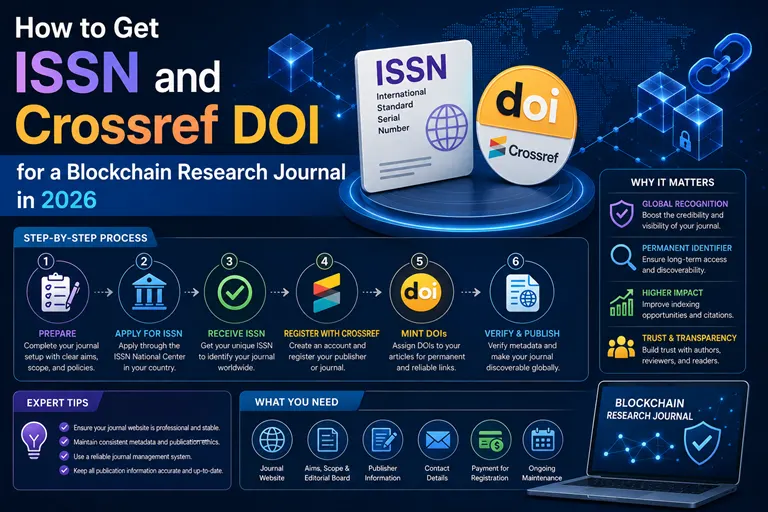
- ISSN (International Standard Serial Number) for identifying the journal itself.
- Crossref DOI (Digital Object Identifier) for permanently identifying every published article.
These identifiers play different but complementary roles in scholarly publishing. An ISSN uniquely identifies a serial publication, while Crossref DOIs provide persistent identifiers for individual research outputs and their metadata.
The Journal of Emerging Trends in Blockchain Technology (JETBT) recognises that proper journal identification and persistent article linking are fundamental to long-term publishing success. This guide explains how editors can prepare a blockchain research journal for ISSN registration and Crossref DOI implementation in 2026.
Understanding ISSN and Crossref DOI
What is an ISSN?
An International Standard Serial Number (ISSN) is an internationally recognised eight-digit identifier assigned to serial publications such as academic journals. It helps libraries, databases, publishers, and indexing services distinguish one journal from another.
For online journals, an electronic ISSN (e-ISSN) is generally assigned.
What is a Crossref DOI?
A Digital Object Identifier (DOI) is a persistent identifier assigned to individual research outputs such as journal articles.
Through Crossref, publishers register article metadata together with a DOI so that the publication remains permanently discoverable even if website URLs change.
Why Blockchain Journals Need ISSN and DOI
Academic Credibility
Authors are more likely to submit manuscripts to journals that demonstrate professional publishing standards.
Better Discoverability
ISSN and DOI improve visibility in:
- Library catalogues
- Academic search engines
- Citation databases
- Research repositories
Long-Term Citation Stability
A DOI provides a permanent scholarly reference that continues to resolve correctly even when website structures change.
Indexing Readiness
Many indexing services expect journals to maintain consistent publication metadata, including journal title and ISSN information. Crossref likewise expects journal metadata to remain consistent across deposits.
Step 1: Define Your Journal Properly
Before applying for an ISSN, clearly establish:
- Journal title
- Scope and aims
- Editorial policy
- Publication frequency
- Peer-review process
- Open access policy
- Copyright policy
A well-defined journal identity simplifies future indexing and metadata management.
Step 2: Build a Professional Journal Website
Your journal website should contain dedicated pages for:
- Home
- About Journal
- Aims and Scope
- Editorial Board
- Ethics and Publication Policy
- Peer Review Policy
- Instructions for Authors
- Contact Information
- Archive
- Current Issue
- Manuscript Submission
Professional presentation demonstrates publishing readiness and supports ISSN applications.
Step 3: Prepare for ISSN Registration
Information Typically Required
Although requirements differ by national ISSN centres, publishers generally need:
- Journal title
- Publisher details
- Website
- Editorial information
- Publishing format
- Publication status
ISSNs are issued through national ISSN centres operating within the international ISSN network.
Common Mistakes
Many new journals experience delays because of:
- Incomplete journal policies
- Missing editorial information
- Unprofessional website design
- Poor publication structure
- Inconsistent metadata
Why Professional ISSN Consulting Helps
Many editors are subject experts rather than publishing specialists.
OJSCloud helps publishers prepare journals for ISSN readiness by providing:
- Journal website development
- Publishing consultation
- ISSN documentation guidance
- Editorial workflow planning
- Technical publishing support
This preparation reduces common application issues and creates a stronger publishing foundation.
Step 4: Establish Editorial Workflow
Before planning DOI registration, your journal should have:
- Structured manuscript submission
- Editorial screening
- Reviewer assignment
- Revision management
- Acceptance workflow
- Production workflow
- Publication scheduling
Modern workflow management significantly improves publishing quality.
Why ScholarJMS Simplifies Journal Publishing
Managing blockchain journals through email quickly becomes inefficient.
ScholarJMS provides:
- Professional journal website
- Online manuscript submission
- Editorial workflow automation
- Reviewer management
- Article production management
- Publication scheduling
- SEO-friendly article pages
- Metadata-ready publishing
This integrated approach helps journals operate efficiently while supporting future indexing goals.
Need Help Launching Your Blockchain Journal?
Whether you are starting a university journal or upgrading an existing publication, we can help.
Our services include:
- ScholarJMS journal website setup
- OJS migration
- Editorial workflow implementation
- ISSN consulting
- Publishing consultation
- Journal launch guidance
WhatsApp: +91 82003 85143
Email: inquiry@ojscloud.com
Step 5: Plan Crossref DOI Registration
Why DOI Planning Matters
DOIs improve:
- Citation tracking
- Research discoverability
- Persistent access
- Metadata quality
Publishers become eligible to register content after obtaining Crossref membership (or working through an approved sponsoring organisation), receiving a DOI prefix, and depositing publication metadata.
Metadata Quality
Every DOI registration should include accurate metadata such as:
- Article title
- Authors
- ORCID identifiers (where available)
- Abstract
- Keywords
- Publication date
- Volume
- Issue
- Journal title
- ISSN
Consistent metadata improves interoperability and discoverability.
How GetDOI Supports Blockchain Journals
Many new publishers find DOI registration technically challenging.
GetDOI provides assistance with:
- Crossref onboarding
- DOI workflow planning
- Metadata preparation
- DOI registration guidance
- Ongoing metadata management
This allows editors to focus on publishing quality rather than technical implementation.
Planning for Future Indexing
ISSN and DOI are important building blocks but do not automatically result in indexing.
Editors should also focus on:
- High-quality peer review
- Ethical publishing
- Consistent publication schedules
- Editorial transparency
- Metadata quality
- Professional journal website
- International editorial participation
These factors collectively improve long-term indexing readiness.
Common Mistakes New Blockchain Journals Should Avoid
Applying Too Early
Do not rush ISSN or DOI planning before your journal website and editorial structure are complete.
Poor Website Design
A weak journal website affects credibility and author confidence.
Manual Workflow
Managing submissions through email increases delays and administrative errors.
Ignoring Metadata
Incomplete metadata reduces article visibility and citation potential.
Irregular Publishing
Consistency remains one of the strongest indicators of journal quality.
Best Practices for Sustainable Growth
Successful blockchain journals should focus on:
- Strong editorial governance
- Transparent peer review
- Professional publication ethics
- High-quality metadata
- Persistent identifiers
- Modern publishing infrastructure
- International collaboration
Together, these practices create a journal that attracts quality submissions and prepares for future indexing opportunities.
Frequently Asked Questions
Is ISSN mandatory for a blockchain research journal?
While publication may technically begin without an ISSN, obtaining one is strongly recommended because it formally identifies the journal and supports discoverability.
Does every article need a DOI?
Assigning a DOI to every published article is considered best practice because it provides a permanent scholarly identifier and improves citation tracking.
Can a new journal register Crossref DOIs?
Yes. Publishers can register DOIs by becoming a Crossref member or working through a sponsoring organisation, provided they meet the relevant requirements.
Should DOI planning begin before publication?
Yes. Planning DOI workflows early helps ensure consistent metadata and smoother publication processes.
Can existing journals upgrade their publishing workflow?
Absolutely. Many journals modernise their websites, editorial workflows, DOI processes, and metadata management without changing their academic scope.
Conclusion
Launching a successful blockchain research journal requires careful planning, professional publishing practices, and reliable scholarly infrastructure. While ISSN establishes the journal's identity, Crossref DOIs ensure that every published article remains permanently identifiable and discoverable within the global research ecosystem.
By combining a professionally designed journal website, an efficient editorial workflow, consistent metadata, and long-term publishing planning, new journals can establish a strong foundation for future growth and indexing.
The Journal of Emerging Trends in Blockchain Technology (JETBT) encourages publishers, universities, and scholarly societies to adopt internationally recognised publishing standards that strengthen research visibility and academic credibility.
If you are planning to launch or modernise your blockchain journal, our team can assist you with:
- ScholarJMS journal website setup
- OJSCloud hosting and migration
- ISSN consulting
- Crossref DOI support through GetDOI
- Editorial workflow implementation
- Complete journal launch consulting
WhatsApp: +91 82003 85143
Email: inquiry@ojscloud.com