
Central Bank Digital Currencies (CBDCs): Architecture, Policy Challenges, and Research Opportunities
Introduction
The global financial system is undergoing a significant transformation as central banks explore the development and deployment of Central Bank Digital Currencies (CBDCs). Unlike cryptocurrencies, CBDCs are sovereign digital currencies issued and regulated by central authorities, aiming to combine the efficiency of digital payments with the stability of traditional monetary systems.
In 2026, CBDCs have moved from conceptual discussions to pilot implementations and policy experimentation across multiple countries. Governments and financial institutions are increasingly recognising their potential to modernise payment systems, improve financial inclusion, and strengthen monetary control.
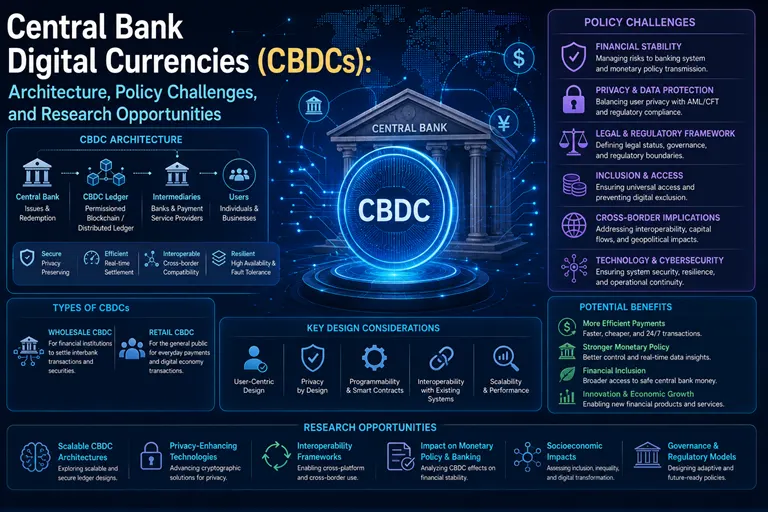
The Journal of Emerging Trends in Blockchain Technology (JETBT) identifies CBDCs as a crucial research area at the intersection of blockchain technology, economics, public policy, and financial systems. This article explores CBDC architectures, policy challenges, and research opportunities shaping the future of digital currencies.
Understanding Central Bank Digital Currencies
What is a CBDC
A Central Bank Digital Currency is a digital form of a country’s fiat currency issued and backed by its central bank.
CBDCs are designed to function as legal tender, offering the same trust and stability as physical currency while enabling digital transactions.
Types of CBDCs
Retail CBDCs
Designed for use by the general public for everyday transactions.
Wholesale CBDCs
Used by financial institutions for interbank settlements and large-value transactions.
Key Objectives
CBDCs aim to:
- Enhance payment system efficiency
- Reduce reliance on cash
- Improve financial inclusion
- Strengthen monetary policy implementation
CBDC Architecture
Centralised vs Distributed Models
CBDCs can be implemented using different architectural approaches.
Centralised Architecture
In this model, the central bank maintains full control over the digital currency system.
Advantages include:
- Simplified management
- Strong regulatory control
- Efficient transaction processing
Distributed Ledger-Based Architecture
CBDCs can also be built using blockchain or distributed ledger technologies.
Benefits include:
- Enhanced transparency
- Improved resilience
- Decentralised validation mechanisms
Hybrid Models
Many central banks are exploring hybrid architectures that combine centralised control with distributed infrastructure to balance efficiency and resilience.
Core Components of CBDC Systems
Digital Wallets
Users access CBDCs through digital wallets provided by banks or authorised service providers.
Identity and Authentication
Secure identity verification systems are essential to prevent fraud and ensure compliance.
Transaction Processing
Efficient and scalable transaction systems are required to handle large volumes of payments.
Integration with Financial Systems
CBDCs must integrate seamlessly with existing banking and payment infrastructures.
Policy Challenges in CBDC Implementation
Monetary Policy Implications
CBDCs may affect interest rates, money supply, and overall economic stability.
Financial Stability Risks
Large-scale adoption of CBDCs could impact traditional banking systems, including:
- Bank deposits
- Liquidity management
- Credit availability
Privacy vs Transparency
Balancing user privacy with regulatory requirements is a key challenge.
Regulatory Frameworks
CBDCs must comply with:
- Anti-money laundering regulations
- Know Your Customer requirements
- Cross-border financial laws
Cybersecurity Concerns
CBDC systems must be resilient against cyberattacks and system failures.
CBDCs and Blockchain Technology
Role of Blockchain
Blockchain can enhance CBDC systems by providing:
- Secure transaction records
- Transparent audit trails
- Distributed validation
Advantages of Blockchain-Based CBDCs
- Improved resilience against single points of failure
- Enhanced transparency for regulatory oversight
- Support for programmable money through smart contracts
Limitations
- Scalability challenges
- Energy consumption concerns
- Complexity in implementation
Real-World Applications of CBDCs
Digital Payments
CBDCs enable fast, secure, and low-cost digital transactions.
Cross-Border Transactions
CBDCs can simplify international payments and reduce reliance on intermediaries.
Financial Inclusion
Digital currencies can provide access to financial services for unbanked populations.
Government Services
CBDCs can be used for:
- Direct benefit transfers
- Tax payments
- Public service delivery
Research Opportunities in CBDCs
Scalable Infrastructure Design
Developing systems capable of handling national-scale transaction volumes.
Privacy-Preserving Mechanisms
Integrating cryptographic techniques to protect user data.
Interoperability
Ensuring compatibility between different CBDC systems and existing financial networks.
Economic Impact Analysis
Studying the effects of CBDCs on financial systems and global economies.
Smart Contract Integration
Exploring programmable money for automated financial processes.
Interdisciplinary Perspectives
Economic Considerations
CBDCs influence monetary policy, financial markets, and economic stability.
Legal and Regulatory Aspects
Legal frameworks must adapt to digital currency systems.
Technological Innovation
Advancements in blockchain, cryptography, and digital infrastructure are driving CBDC development.
Why This Topic Matters for Researchers
CBDCs represent a convergence of technology, economics, and public policy.
Researchers can contribute by:
- Designing efficient CBDC architectures
- Addressing privacy and security challenges
- Analysing economic impacts
- Developing interoperable systems
JETBT encourages research that advances understanding of digital currencies and their role in modern financial systems.
Frequently Asked Questions
What is a CBDC?
It is a digital version of a country’s fiat currency issued by its central bank.
How is CBDC different from cryptocurrency?
CBDCs are regulated and backed by central banks, while cryptocurrencies are decentralised and not tied to any authority.
Why are countries developing CBDCs?
To improve payment efficiency, enhance financial inclusion, and modernise monetary systems.
What are the main challenges?
Privacy concerns, regulatory issues, scalability, and financial system impact.
Are CBDCs based on blockchain?
Some use blockchain, while others use centralised or hybrid architectures.
Conclusion
Central Bank Digital Currencies are reshaping the future of monetary systems by combining the stability of traditional currencies with the efficiency of digital technologies. As governments and financial institutions continue to explore CBDC implementations, the importance of robust architecture, sound policy frameworks, and advanced technological solutions becomes increasingly evident.
While challenges related to privacy, scalability, and financial stability remain, ongoing research and innovation are paving the way for practical and sustainable solutions.
The Journal of Emerging Trends in Blockchain Technology (JETBT) remains committed to publishing high-quality research that explores CBDCs and their impact on global financial systems.
Researchers, institutions, and policymakers are encouraged to contribute to this evolving field and help shape the future of digital currency ecosystems.