
Blockchain in Supply Chain Management: Transparency, Traceability, and Risk Reduction
Introduction
Global supply chains have become increasingly complex, involving multiple stakeholders, geographies, and processes. While this complexity enables large-scale production and distribution, it also introduces challenges related to transparency, traceability, inefficiency, and risk management.
In 2026, blockchain technology is emerging as a transformative solution for addressing these challenges. By providing a decentralised, tamper-proof, and transparent ledger, blockchain enables real-time visibility and trust across supply chain networks.
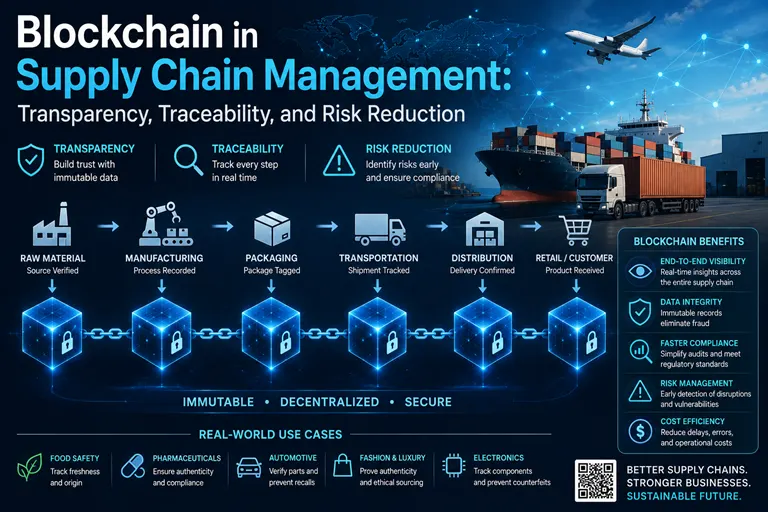
The Journal of Emerging Trends in Blockchain Technology (JETBT) highlights supply chain management as a critical application area where blockchain can bridge the gap between digital systems and real-world operations. This article explores how blockchain enhances transparency, improves traceability, and reduces risks in modern supply chains.
Understanding Supply Chain Challenges
Complexity and Fragmentation
Modern supply chains involve manufacturers, suppliers, distributors, logistics providers, and retailers. These entities often operate on separate systems, leading to fragmented data and limited visibility.
Lack of Transparency
Traditional supply chains rely on centralised databases, making it difficult to verify data authenticity and track product movement.
Limited Traceability
Tracking the origin and journey of products is often time-consuming and prone to errors.
Risk and Fraud
Supply chains are vulnerable to:
- Counterfeit products
- Data manipulation
- Delays and disruptions
- Compliance failures
How Blockchain Transforms Supply Chains
Decentralised Data Sharing
Blockchain enables all participants in a supply chain to access a shared, immutable ledger.
Benefits include:
- Real-time data synchronisation
- Reduced dependency on intermediaries
- Improved collaboration
Immutable Record Keeping
Once data is recorded on the blockchain, it cannot be altered. This ensures data integrity and trust among stakeholders.
Smart Contracts for Automation
Smart contracts automate processes such as:
- Payment execution upon delivery
- Verification of shipment conditions
- Compliance checks
Enhancing Transparency
Real-Time Visibility
Blockchain provides end-to-end visibility of supply chain activities, allowing stakeholders to monitor transactions and product movement in real time.
Trust Among Participants
Transparent systems reduce disputes and build trust between suppliers, manufacturers, and customers.
Regulatory Compliance
Blockchain simplifies compliance by providing auditable records for regulators and auditors.
Improving Traceability
Product Origin Tracking
Blockchain enables tracking of products from raw materials to final delivery.
Batch and Lot Tracking
Detailed tracking of batches helps identify issues quickly and efficiently.
Recall Management
In case of product defects, blockchain allows rapid identification and recall of affected products.
Industry Applications
Traceability is particularly valuable in:
- Food supply chains
- Pharmaceutical distribution
- Luxury goods authentication
- Electronics manufacturing
Risk Reduction in Supply Chains
Fraud Prevention
Immutable records make it difficult for malicious actors to alter data or introduce counterfeit products.
Improved Data Accuracy
Shared ledgers reduce discrepancies between different systems.
Supply Chain Resilience
Blockchain helps identify disruptions and enables proactive risk management.
Cybersecurity Benefits
Decentralised systems reduce the risk of single points of failure and large-scale data breaches.
Integration with Emerging Technologies
Internet of Things
IoT devices can feed real-time data into blockchain systems, improving accuracy and automation.
Artificial Intelligence
AI can analyse blockchain data to optimise logistics, predict demand, and detect anomalies.
Digital Identity Systems
Blockchain-based identity systems ensure that only authorised participants interact within the supply chain.
Enterprise Blockchain in Supply Chains
Permissioned Networks
Enterprises often use permissioned blockchain systems to control access and ensure confidentiality.
Consortium Models
Multiple organisations collaborate to create shared blockchain platforms for supply chain management.
Integration with Legacy Systems
Research is needed to integrate blockchain with existing enterprise systems seamlessly.
Challenges in Blockchain Adoption
Scalability Issues
Handling large volumes of transactions remains a challenge.
Standardisation
Lack of common standards limits interoperability between systems.
Implementation Costs
Initial setup and integration can be resource-intensive.
Change Management
Adopting new technology requires organisational and cultural changes.
Future Research Directions
Interoperable Supply Chain Systems
Developing systems that allow seamless communication between different blockchain networks.
Privacy-Preserving Data Sharing
Ensuring confidentiality while maintaining transparency.
Sustainable Supply Chain Models
Using blockchain to support environmentally sustainable practices.
Advanced Analytics
Combining blockchain data with AI for predictive insights and optimisation.
Interdisciplinary Perspectives
Economic Impact
Blockchain can reduce operational costs and improve efficiency.
Legal and Regulatory Considerations
Compliance with international trade laws and data regulations is essential.
Social Implications
Transparent supply chains promote ethical sourcing and consumer trust.
Why This Topic Matters for Researchers
Blockchain in supply chain management is a rapidly growing research area with real-world impact.
Researchers can contribute by:
- Developing scalable blockchain solutions
- Designing interoperable systems
- Exploring industry-specific applications
- Addressing regulatory and ethical challenges
JETBT encourages submissions that advance supply chain innovation through blockchain technology.
Frequently Asked Questions
How does blockchain improve supply chains?
It enhances transparency, traceability, and trust by providing a shared and immutable ledger.
What industries benefit the most?
Food, pharmaceuticals, logistics, and manufacturing are key beneficiaries.
Can blockchain prevent fraud?
It significantly reduces fraud by ensuring data integrity and traceability.
What are the challenges?
Scalability, cost, standardisation, and integration are major challenges.
What is the future of blockchain in supply chains?
Greater adoption, integration with AI and IoT, and development of interoperable systems.
Conclusion
Blockchain technology is redefining supply chain management by enabling transparent, traceable, and secure systems. As global supply chains continue to evolve, the need for reliable and efficient infrastructure becomes increasingly important.
While challenges remain, ongoing research and innovation are driving the development of scalable and practical solutions. The integration of blockchain with emerging technologies further enhances its potential to transform supply chain operations.
The Journal of Emerging Trends in Blockchain Technology (JETBT) remains committed to publishing high-quality research that explores these advancements and their real-world applications.
Researchers, institutions, and industry professionals are encouraged to contribute to this evolving field and help build the next generation of intelligent supply chain systems.