
Blockchain Governance Models: DAO Structures, Voting Mechanisms, and Research Challenges
Introduction
Governance is a foundational element of any system, determining how decisions are made, rules are enforced, and stakeholders interact. In traditional systems, governance is typically centralised, relying on institutions or authorities to manage operations.
Blockchain technology has introduced a new paradigm of decentralised governance, where decision-making is distributed among participants rather than controlled by a single entity. This shift has led to the emergence of decentralised autonomous organisations (DAOs), innovative voting mechanisms, and new governance frameworks.
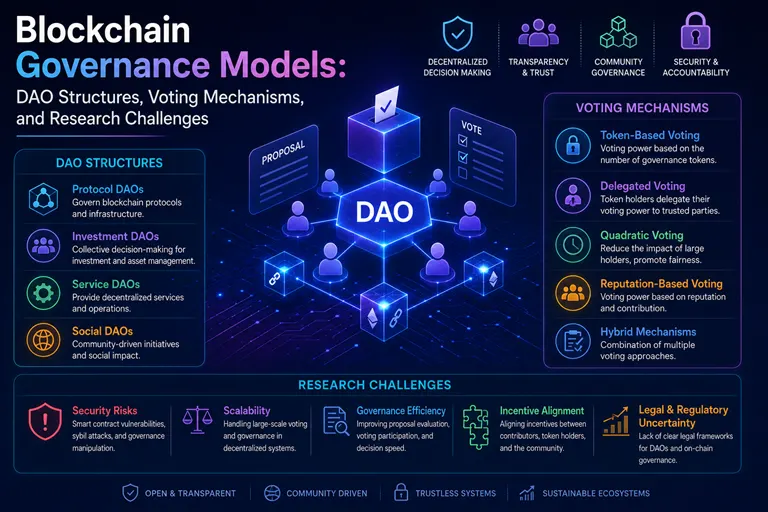
In 2026, blockchain governance has become a critical research area, particularly as decentralised systems scale and interact with real-world institutions. The Journal of Emerging Trends in Blockchain Technology (JETBT) recognises governance as a key pillar of blockchain research, influencing the long-term sustainability and trust of decentralised ecosystems.
Understanding Blockchain Governance
What is Blockchain Governance
Blockchain governance refers to the processes and mechanisms through which decisions are made within a blockchain network. These decisions may include protocol upgrades, resource allocation, dispute resolution, and policy enforcement.
Governance can be broadly categorised into:
- On-chain governance, where decisions are encoded in smart contracts
- Off-chain governance, where decisions are made through discussions and external processes
Importance of Governance in Decentralised Systems
Effective governance ensures:
- Network stability and continuity
- Fair participation of stakeholders
- Adaptability to technological and regulatory changes
- Prevention of malicious behaviour
Without proper governance, decentralised systems may face conflicts, inefficiencies, and fragmentation.
Decentralised Autonomous Organisations (DAOs)
What is a DAO
A decentralised autonomous organisation is a blockchain-based entity governed by smart contracts and community consensus rather than central leadership.
DAOs operate through predefined rules encoded in smart contracts, enabling automated and transparent decision-making.
Key Characteristics of DAOs
- Decentralised control without central authority
- Transparent operations recorded on blockchain
- Token-based participation and governance
- Automated execution of decisions
Types of DAOs
Protocol DAOs
Govern blockchain protocols, including upgrades and technical decisions.
Investment DAOs
Manage collective investment decisions and asset allocation.
Service DAOs
Provide decentralised services such as development, marketing, or consulting.
Social DAOs
Focus on community building and shared interests.
Voting Mechanisms in Blockchain Governance
Token-Based Voting
Token holders participate in governance by voting proportional to their token holdings.
Advantages include simplicity and alignment with economic incentives. However, it may lead to concentration of power among large stakeholders.
Quadratic Voting
Quadratic voting allows participants to allocate votes based on preference intensity while reducing the influence of large token holders.
Delegated Voting
Participants can delegate their voting power to trusted representatives, improving participation and efficiency.
Reputation-Based Voting
Voting power is based on reputation or contribution rather than token ownership, promoting merit-based governance.
Hybrid Models
Modern governance systems often combine multiple voting mechanisms to balance fairness, efficiency, and security.
Governance Challenges in Blockchain Systems
Centralisation Risks
Despite decentralisation goals, governance power can become concentrated among a small group of stakeholders.
Voter Participation
Low participation rates can undermine the legitimacy of governance decisions.
Complexity of Decision-Making
Technical proposals may be difficult for non-expert participants to evaluate.
Governance Attacks
Malicious actors may attempt to manipulate voting systems or exploit governance mechanisms.
Coordination Problems
Achieving consensus among a diverse and global community can be challenging.
Governance in Real-World Applications
Decentralised Finance
Governance determines how DeFi protocols evolve, including changes to fees, incentives, and security mechanisms.
Public Blockchain Networks
Major blockchain platforms rely on governance to implement upgrades and resolve disputes.
Enterprise Blockchain Systems
Enterprises use governance frameworks to manage access, permissions, and operational rules.
Digital Identity Systems
Governance ensures ethical and secure management of identity data.
Research Challenges in Blockchain Governance
Designing Fair Voting Systems
Developing voting mechanisms that balance influence and fairness remains a key challenge.
Incentive Alignment
Ensuring that participants act in the best interest of the network requires well-designed incentive structures.
Governance Scalability
As networks grow, governance systems must handle increasing complexity and participation.
Legal and Regulatory Integration
Blockchain governance must align with existing legal frameworks and regulatory requirements.
Transparency vs Privacy
Balancing openness with confidentiality is a critical issue in governance design.
Emerging Trends in DAO Governance
AI-Assisted Governance
Artificial intelligence is being explored to analyse proposals, predict outcomes, and support decision-making.
Dynamic Governance Models
Adaptive governance frameworks can evolve based on network conditions and user behaviour.
Cross-Chain Governance
Interoperable governance systems allow decision-making across multiple blockchain networks.
Decentralised Identity Integration
Identity systems are being integrated into governance to enhance trust and accountability.
Interdisciplinary Perspectives
Economic Models
Governance decisions influence token economics and network sustainability.
Legal Frameworks
Understanding the legal status of DAOs and governance decisions is essential for adoption.
Social Dynamics
Human behaviour and community engagement play a critical role in governance outcomes.
Why This Topic Matters for Researchers
Blockchain governance is central to the success of decentralised systems.
Researchers can contribute by:
- Designing innovative governance models
- Developing secure voting mechanisms
- Exploring interdisciplinary solutions
- Addressing scalability and participation challenges
JETBT encourages research that advances governance frameworks and supports sustainable blockchain ecosystems.
Frequently Asked Questions
What is blockchain governance?
It refers to how decisions are made and implemented within a blockchain network.
What is a DAO?
A decentralised autonomous organisation governed by smart contracts and community voting.
What are common voting mechanisms?
Token-based, quadratic, delegated, and reputation-based voting are widely used.
What are the main challenges?
Centralisation risks, low participation, governance attacks, and scalability issues.
Why is governance important?
It ensures stability, fairness, and adaptability in decentralised systems.
Conclusion
Blockchain governance models are redefining how organisations and networks operate by introducing decentralised, transparent, and automated decision-making systems. From DAOs to advanced voting mechanisms, governance plays a critical role in ensuring the sustainability and trust of blockchain ecosystems.
However, challenges such as centralisation risks, participation issues, and regulatory complexities highlight the need for continued research and innovation.
The Journal of Emerging Trends in Blockchain Technology (JETBT) remains committed to publishing high-quality research that explores governance frameworks and their real-world applications.
Researchers, institutions, and practitioners are encouraged to contribute to this evolving field and help shape the future of decentralised governance systems.